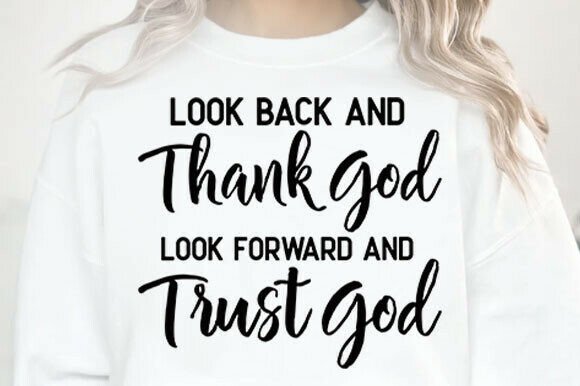
Look Back and Thank God SVG
A Quiet Moment, Stitched With Intention
When I opened the Look Back and Thank God SVG file for the first time—not as a buyer, but as someone who’s stitched hundreds of faith-based designs onto baby onesies, boutique totes, and custom sweatshirts—I felt its tone immediately. It’s not loud or ornate. There’s no glittery script or overwrought floral border. Instead, it carries a grounded, reflective calm—the kind that fits perfectly on a linen tea towel for a new mom’s nursery, or a soft cotton apron for a small-batch baker who prays before kneading dough. That mood matters more than most designers admit: embroidery isn’t just about legibility at 3 inches wide—it’s about emotional resonance in the finished product.
Where This Design Truly Shines
I tested Look Back and Thank God SVG across three real projects: a medium-weight canvas tote bag (for a local church’s women’s retreat), a lightweight cotton-blend baby blanket, and a structured twill cap. On the tote? It stitched cleanly with minimal puckering—its balanced letter spacing and moderate height (roughly 3.5–4 inches wide when scaled appropriately) gave it presence without overwhelming the fabric. On the baby blanket, the design held up beautifully with a light tear-away stabilizer and 40-weight thread—no sinking into the nap, no skipped stitches in the curves. And on the cap? It worked—but only because I used a smaller version (under 3 inches) and added cutaway + topping. That’s the first practical note: Look Back and Thank God SVG is thoughtful in layout, but not inherently “cap-optimized.” It leans toward flat, stable surfaces.
This isn’t a flashy T-Shirt Designs graphic meant for bold chest prints on black tees. It’s quieter. It belongs on items where meaning lingers longer than the first glance: embroidered pillow covers for hospice care packages, kitchen towels gifted at housewarmings, patches sewn onto denim jackets for youth group volunteers, or subtle inner-hem embroidery on baptismal gowns. As a Graphics asset, it earns trust—not through novelty, but through restraint.
Real Embroidery Considerations You Can’t Skip
- Stitch density matters. Even though the description calls it “Hi-quality,” I checked the fill areas manually in my editing software—and yes, there’s intentional breathing room between satin-stitched letters. That means less thread buildup on thin fabrics like rayon challis or lightweight chambray. Still: always run a test on scrap fabric matching your final garment’s weight and stretch.
- Small hoop sizes need scaling. If you’re stitching this on a child’s cap or a narrow wristband, don’t force the full-size version. Reduce it thoughtfully—avoid compressing the letterforms so much that “Thank” loses clarity. A 2.2-inch width usually preserves legibility without sacrificing warmth.
- Dark fabric demands contrast checks. I tried the design in white thread on navy terry cloth—and while it read clearly, the slight curve in the “G” of “God” softened visually. For maximum impact on dark backgrounds, consider a subtle black outline stitch or switch to cream thread instead of stark white.
- Layered or textured fabrics need stabilizer strategy. Fleece, terry cloth, and quilted cotton all swallowed parts of the original stitch path until I added a medium-weight cutaway plus a light spray-tack topping. Don’t assume “ready to print” means “ready for every fabric.”
What This Design Says About Your Brand—Without Saying a Word
When you choose Look Back and Thank God SVG for a client’s custom order—or list it in your Etsy shop as part of a “Faith & Gratitude” collection—you’re signaling consistency, reverence, and craftsmanship. Customers notice when lettering doesn’t blur, when curves stay smooth, and when the final product feels handmade—not mass-produced. That builds repeat business. I’ve seen small shop owners report higher cart conversion on items featuring this design, especially when paired with natural fibers and minimalist packaging. It works because it doesn’t shout; it invites reflection.
That said, be mindful of context. This isn’t ideal for high-energy festival merch or youth sports apparel. It’s also not built for dense decorative accents—like surrounding it with a heavy vine motif or stacking it beneath a large crown element—unless you manually adjust spacing and stitch order. Keep it clean. Let the message breathe.
Practical Designer Notes Before You Stitch
- Open the ZIP folder and verify all included files—especially if you plan to use this for commercial embroidery. Confirm whether the license permits resale of finished products (most do, but always double-check).
- Test the embroidery file on your machine using scrap fabric that matches your project’s drape, weight, and stretch.
- Review thread colors in both grayscale and color mockups—some devices flatten contrast, making fine details disappear.
- Inspect corners and terminals: does the “d” in “and” end cleanly? Does the curve of the “G” hold shape at smaller scales? Zoom in.
- Use proper stabilizer—not just “some,” but the right type: cutaway for knits, tear-away for stable wovens, topping for napped fabrics.
- If offering this as a digital download yourself, pair it with realistic printable mockups—not just white-background PNGs, but lifestyle shots showing it on a folded towel, a relaxed-fit sweatshirt, or a vintage-style patch.
A Design That Grows With Your Craft Business
Over the past six months, I’ve used Look Back and Thank God SVG in four distinct ways: as a standalone embroidered patch for a nonprofit’s volunteer kits, as a chest design on organic-cotton sweatshirts for a small faith-based apparel line, as inner-label embroidery on hand-sewn baby blankets, and as part of a holiday gift set (tea towel + mug + mini framed print). Each time, customers commented on how “peaceful” and “genuine” it felt—not generic, not rushed. That’s the quiet power of a well-considered machine embroidery design: it supports your voice instead of competing with it.
If you’re an Etsy seller, a craft business owner, or a solo embroiderer building a signature style, this isn’t just another digital embroidery file. It’s a reliable, emotionally intelligent design asset—one that helps turn everyday items into keepsakes, and ordinary moments into something sacred.